Wednesday, 28 June 2017

PSA: Petya Ransomware Affecting Critical Systems Globally: Here’s What to Do.

Updated 3:19PM Pacific Time: A method to ‘vaccinate’ yourself against this ransomware variant has been found. I have posted details towards the end of the post along with a batch file you can run. It is as simple as creating the file C:\Windows\perfc and marking it read-only.
Update 2 at 7pm PST on Tuesday: It appears that the initial infection many have come from a company called MeDoc that was breached. Their systems were infected and they then pushed out an update, spreading the infection. MeDoc are disputing the allegation. Sources: Talos quoted on ZDNetForbes and FireEye.

What We Know
A new ransomware variant is spreading quickly across the globe at the time of this writing. There is no consensus yet in the security research community, so the following information is provisional in nature:
The ransomware has been dubbed “Petya.” It likely spreads by using two separate exploits. You don’t need to click on anything or take any action. This can spread into your system through the network. That is why it is having such a wide impact and why it is important that you update your system to protect yourself.
For the technically minded: This ransomware is exploiting a vulnerability in Microsoft Office when handling RTF documents (CVE-2017-0199). It also exploits a vulnerability in SMBv1 which is the Microsoft file-sharing protocol. This second vulnerability is described in Microsoft security bulletin MS17-010.
The ransomware has affected a large number of companies, organizations and government entities on an international scale. The following is a screenshot of the ransomware page you are confronted with once your files are encrypted:
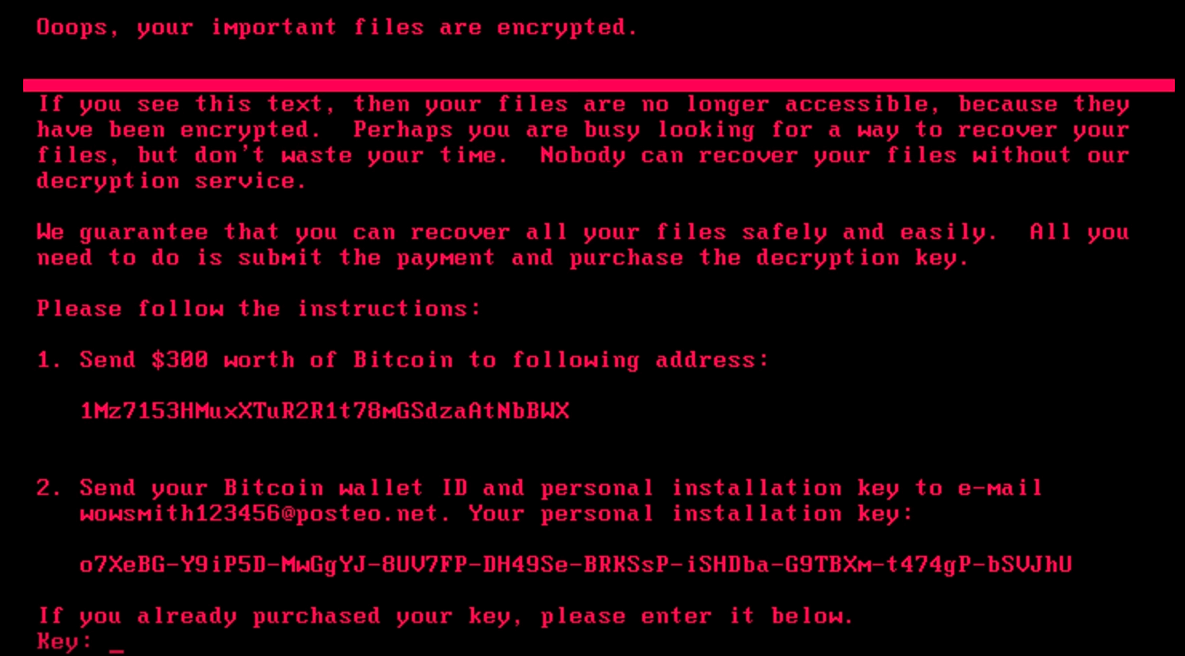
Colin Hardy has provided a behavioral analysis of Petya, which includes a video demonstration of the malware in action:

What To Do

If you have not done so already, you should immediately install the MS17-010 patch from Microsoft.
If you currently run an unpatched Windows system, you may not have time to patch it before you are infected. Consider shutting down your machine, if feasible, and leaving it off the network until there is consensus in the research community on what this exploits and how to protect against it.
If you are technically able to, we recommend you block network access to port 445 on your Windows workstations. You may also want to monitor traffic to that port if you are a security professional.
Keep an eye on the Microsoft Security Response Center where they will hopefully release formal guidance soon.
Update your anti-virus definitions and run a scan on your system. You can find out which anti-virus products are detecting the current variant of Petya on this VirusTotal page. I’ve linked to one of the files involved in the infection. The page shows which AV vendors are currently detecting this file. The green check marks mean the file is not detected by that AV vendor (it’s counterintuitive).

Who This Has Affected So Far

  • A Ukrainian state power company and Kiev’s main airport were among the first to report issues.
  • The Chernobyl nuclear power plant has had to monitor radiation levels manually after they were forced to shut down the Windows systems that their sensors had been using.
  • Antonov aircraft has reported being affected.
  • Copenhagen-based shipping company Maersk is experiencing outages in multiple IT systems and across multiple business units.
  • Food giant Modelez, which makes Oreo and Toblerone, has also been hit.
  • Netherlands-based shipping company TNT was also hit.
  • French construction company St. Gobain has been affected.
  • Pharmaceutical company Merck says they have systems affected.
  • Law firm DLA Piper was hit.
  • Heritage Valley Health System, a US hospital operator, has also been hit.
  • Kiev’s metro system has stopped accepting payment cards because they were affected.
The list is long and growing; the above just a snapshot.

Strong Incentive for Attackers

Many are reporting the belief that the South Korean hosting company that paid attackers a $1M ransom a week ago to recover their data have created a huge incentive for future ransomware attacks.
That has resulted in this new spate of attacks affecting systems globally.

Coverage of This Story

Update 3:19pm PST: A Vaccine has been Found

In the past couple of hours researchers have found a ‘vaccine’ against having your files encrypted by this new variant of Petya. They discovered that if a file exists, the encryption routine will not run.
Amit Serper who found this had their findings confirmed by other security researchers.
To vaccinate a machine against this ransomware, simply create a file called perfc in the C:\Windows folder and mark it read only. The following batch file courtesy of BleepingComputer will do the job for you:
This post in BleepingComputer also includes instructions on how to create the file manually if you would prefer to do that. Once this file is created, the encryption routine for this specific ransomware variant will not run and encrypt your files.

Help Keep the Community Safe

We recommend you let your friends and family know about this fast spreading campaign as a matter or urgency to help them stay safe.

Friday, 13 January 2017

Highly Effective Gmail Phishing Technique Being Exploited

A new highly effective phishing technique targeting Gmail and other services has been gaining popularity during the past year among attackers. Over the past few weeks there have been reports of experienced technical users being hit by this.
This attack is currently being used to target Gmail customers and is also targeting other services.
The way the attack works is that an attacker will send an email to your Gmail account. That email may come from someone you know who has had their account hacked using this technique. It may also include something that looks like an image of an attachment you recognise from the sender.

Wednesday, 21 December 2016

Monday, 12 December 2016

Wordfence Blocks Username Harvesting via the New REST API in WP 4.7

WordPress 4.7 was released 6 days ago, on December 6th. It includes a REST API that will be used by many WordPress plugins, mobile apps, desktop applications, cloud services and even WordPress core in future. Every site that upgrades to WordPress 4.7 has this API enabled by default.

Wednesday, 30 November 2016

Emergency Bulletin: Firefox 0 day in the wild. What to do.

We’re publishing this as an emergency bulletin for our customers and the larger web community. A few hours ago a zero day vulnerability emerged in the Tor browser bundle and the Firefox web browser. Currently it exploits Windows systems with a high success rate and affects Firefox versions 41 to 50 and the current version of the Tor Browser Bundle which contains Firefox 45  ESR.
If you use Firefox, we recommend

Wednesday, 17 August 2016

WP Plugin 404 to 301 - Considered Harmful

Yesterday we received a site cleaning request where one of our customers was seeing spammy links, Payday Loans in this case, injected into their WordPress website page content. The links were only appearing when the site was visited by a search engine crawler. This is common when a site has been hacked.

It turns out that this is not a hacked site. It is content that is injected by a plugin called 404 to 301 plugin which has 70,000 active installs and has a 4.5 star review from 56 reviewers. When you install the plugin it asks you to agree to a long agreement which includes parts of the GNU general public license. But at the end it also includes the following text:

Wednesday, 13 July 2016

New Vulnerability in All in One SEO Pack Plugin 2.3.7 and earlier

Yesterday morning Panagiotis Vagenas, a Wordfence Security Researcher, discovered a new vulnerability in the All in One SEO Pack WordPress plugin. This is in addition to another serious vulnerability we wrote about yesterday morning in the same plugin.
As detailed yesterday, All in One SEO Pack is an extremely popular plugin with over 1,000,000 active installs. Both free and Premium Wordfence users with the firewall enabled had partial protection at the time we discovered this new vulnerability.

Friday, 6 May 2016

Vulnerability in Yoast SEO 3.2.4 for WordPress


The team of Wordfence discovered a vulnerability in Yoast SEO version 3.2.4 and earlier that allows any user with ‘subscriber’ level access to download your Yoast SEO settings. For sites that have open registration, this means that anyone can register and download your Yoast SEO settings by simply creating an account and running the exploit.

Saturday, 30 April 2016

Decentralized social networks

What is Friendica and why should I bother using it?


Friendica is open source software that implements a decentralized social network. It provides a wide range of connectors to other social networks. Connect with friends on App.net, Diaspora, GNU Social, Pump.io or Twitter. You can import RSS feeds and post to Facebook, Libertree, Wordpress, Tumblr, Google+ pages and more. You can even interact via mail.

Why Friendica?

Saturday, 9 April 2016

Panama Papers: How they hacked!

Email Hackable via WordPress, Docs Hackable via Drupal

The Mossack Fonseca (MF) data breach, aka Panama Papers, is the largest data breach to journalists in history and includes over 4.8 million emails.
Yesterday we broke the story that MF was running WordPress with a vulnerable version of Revolution Slider and the WordPress server was on the same network as their email servers when the breach occurred.

Monday, 14 March 2016

LiFi internet: First real-world usage boasts speed 100 times faster than WiFi

Li-Fi, a super-fast alternative to Wi-Fi, is finally moving from research labs to the real world after an Estonian startup implemented the technology within a commercial context. Velmenni, a recent finalist at the Slush 100 startup competition in Helsinki, revealed that it has begun trialling the technology within offices and industrial environments in Tallinn.

Wednesday, 24 February 2016

WordPress delivered Ransomware and Hacked Linux Distributions

In a rather unfortunate turn of events earlier this month, the Hollywood Presbyterian Medical Center was infected with ransomware. Ransomware, if you’re unfamiliar with it, encrypts everything on your workstation and then tells you to pay an attacker to decrypt your system and regain access to your information.
In the case of Presbyterian, they had to pay 40 bitcoins or the equivalent of $17,000 to regain access to their systems. The ransomware attack affected CT scans, documentation, lab work, pharmacy functions and their email went down. Last week they paid the attacker the $17,000 and their systems were decrypted and they’re back online.

Wednesday, 27 January 2016

Google ending support for 32-Bit Chrome for Linux, Debian 7 and Ubuntu 12.04

Google announced that it will drop support for 32-bit version of Linux, Debian 7 (Wheezy) and Ubuntu 12.04 (Precise).

Users affected will still be able to use Chrome after the axe has fallen, but they will no longer receive any updates. 
In a double-whammy, March will also see Google Chrome stop supporting Ubuntu 12.04 LTS (which will receive critical and security bug fixes from Canonical until mid 2017).

Tuesday, 26 January 2016

WordPress Security: Core XSS and 4 Plugin vulnerabilities

This has certainly been an eventful month in WordPress security. January 6th saw a WordPress core security update. Upgrade immediately to version 4.4.1 of WordPress core if you haven’t already.
The vulnerability that WordPress 4.4.1 fixes is a cross site scripting or XSS vulnerability.

Tuesday, 8 December 2015

LastPass - The last password you have to remember

Security and automation are imperative if you want to succeed in today’s online world. Needing access from any device on any place can make life a bit confusing. Everyday at Azorvida we’re working on different projects. But our workload is more manageable and smoother because all of our admin passwords are tightly held inside LastPass. So long are the days of writing every password down, or saving them on a file.

Tuesday, 27 October 2015

The Art of Project Management and how to do it


Which is the best To Do List / Task Management application that also has Project Management features ?

Each of the different system we tried had many awesome features, but none of them seemed perfect to us. After a short time, we'd abandon one in lieu of another and felt like we repeated the cycle endlessly. We tried others and spent much time simply updating an Google Spreadsheet. We've often been frustrated with the lack of a "perfect" application (for us, of course - We know this is a decision of needs).

Wednesday, 21 October 2015

Happy 11th Birthday, Ubuntu!


It's hard to believe that 11 years have passed since the launch of Ubuntu 4.10 "The Warty Warthog". Yes, it’s now been eleven years, and some twenty-two releases of Ubuntu, since Mark Shuttleworth sat down to type up the first ever Ubuntu release announcement.

This first Ubuntu OS, was a rough and ready stab at bringing Linux to the masses.

Friday, 16 October 2015

Browser Update

Browser-Update.org

An initiative by web designers to inform users about browser-updates


This service is an opportunity to inform your visitors unobtrusively to switch to a newer browser. Many internet users are still using very old, out-dated browsers – most of them for no actual reason. Switching to an newer browser is better for them and for you as a web designer.

How it works

Wednesday, 14 October 2015

Azorvida IT Services - NOW also in DE


Finally, Azorvida IT Services is also available in German. But, it was not ONLY the language, which inspired me to this job. While the English version is based on Bootstrap I played a little bit around and created the German version on materialize.css which is a Framework using Google's Material Design.